3-wheelers

Structural design considerations (for 3-wheeled transportation)
Based on an observation of bare-bones, cost-optimised operational designs.
Definition:
A single front-wheel, and a 2 wheel rear-axle.
Drive trains:
DC-motor, ICE, or pedal-powered.
Primary design considerations:
1) Ratio of wheelbase (distance from front wheel spindle to center of rear-wheel-axle) to rear-axle-width (WB/RAW ratio).
2) Diameter of front wheel, rear wheels
3) Width of tires.
1 effects vehicle stability and aerodynamics. A large ratio is less stable and more difficult to turn, but has better aerodynamics.
2 & 3 effect engine-load, shock-absorption and road-drag.
Larger wheels travel longer per turn, hence lower engine r.p.m is required to achieve a given speed, but also greater low-end torque.
Wider tires introduce greater road-drag but improve shock-absorption.
ICE based designs use very small wheels (10-12") and wide tires (10-12cm), and a WB/RAW ratio close to 1.25.
This provides good stability at high speeds (50 kmph).
The inefficiency of using smaller wheels and the extra drag created by wider tires is compensated for by the higher r.p.m available in an internal combustion engine.
DC-motor based designs have higher low-end torque and operate at lower rpm.
They use slightly bigger wheels (14"), for greater efficiency and slightly narrower tires (6-8 cm wide) to reduce drag.
They use a WB/RAW ratio close to 2.25.
These designs operate at intermediate speeds (30 kmph) and turn slowly to maintain stability.
Non-motorized designs use 28" bicycle wheels, narrow bicycle tires, about 3 cm wide and a rear-axle width of about 1m (designed to accommodate 2 passengers) and a WB/RAW ratio of about 1.25 for passenger-carrying designs or 1.5 - 2.0 for load-carrying designs. These designs move at under 10 kmph and are very stable at these speeds.
A key design consideration in 3-wheeled transportation is reducing the effect of road-bumps on the rear wheels.
These bumps are usually uneven (hitting only a single rear wheel at a time), and due to the presence of only a single front wheel, they tend to twist the vehicle (like lifting a triangular plate from one corner).
The effect of rear axle bumps can be reduced by using
1) a lower WB/RAW ratio, 2) smaller wheels, 3) wider tires and 4) lower bump traversal speeds.
The worst effected are DC-motor based designs, since they have a very large WB/RAW ratio
(or a narrow isosceles triangle), and negotiate bumps at intermediate motorised speeds. A small displacement of one rear wheel is felt along the length of the vehicle.
Shock-absorbers:
Motorised designs,
since they are designed quite heavy for motor-driven speeds, typically use small pneumatic shock-absorbers coupled with coil-springs.
Low-speed, non-motorized designs, designed lighter, use some form of leafspring.
Specification

Review of existing designs
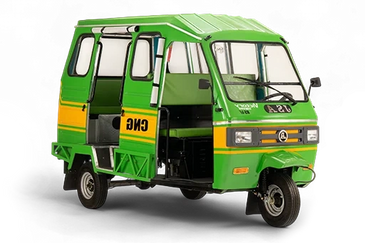
JSA CNG
CNG Engine
12 in wheels
WB/RWA = 1.75

E-Rickshaw
DC Motor
14 in wheels
WB/RWA = 2.25
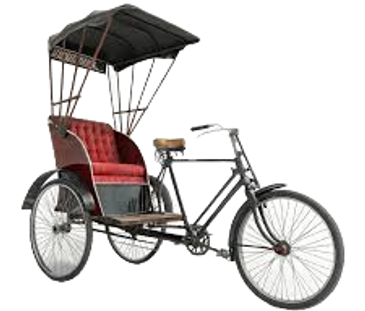
Cycle-rickshaw
Cycle-rickshaw
Pedal powered
28 in wheels
WB/RWA = 1.5